eswarm

Evilswarm Training ft. Laggia

Hey guys and gals, Matt returns for another shot at deck experimentation as a result of the HA7 release.

When I sat down and decided to play Evilswarms, I anticipated a deck of wonders that most men (and woman) dare not dream of. Instead, what I got was a fairly unexciting deck that boasted very little complexity beyond “Summon Ophion… …wait to win?”

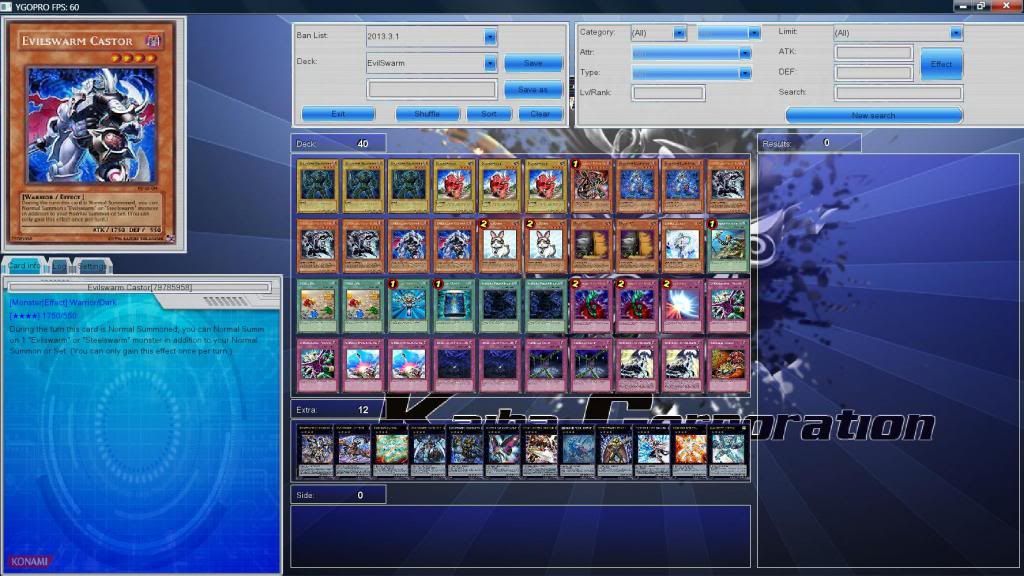
I needed more, something that gave me the opportunity to put down monsters whose inherent purpose was not XYZ fodder. I decided that Ninjas, Dinosaurs and Rabbits would form the base of the deck, with support that could be dropped or reinforced, depending on how the deck performed. Here’s a link for your reference: [Link].

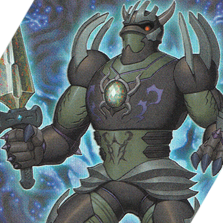
Rabbit provides both Ophion and Laggia. The goal is to ensure Rabbit is always live with the crazy amount of Normals in the deck. It’s not a new concept (VerzLaggia), but it fit my direction perfectly.

The high Normal Monster count is intended to be a positive aspect of the deck. The Heliotropes can be recycled back into the deck with Infestation Infection when they’re drawn, summoned alongside Evilswarm Castor, or used as a 1950 body to get over pesky defensive monsters and Thunder King. There’s also the added bonus of Daigusto Emeral being able to bring these Normal Monsters back for additional plays.

The Sabersauri work in tandem with Rabbit and Hanzo to be brought out of the deck quickly. For any that are drawn, Evilswarm Salamandra, (as well as Hanzo) can be summoned alongside it to make Laggia, since Salamandra is a Dinosaur. Of course, 1 stray Sabersaurus is a great tool to test an opponent’s defenses, allowing Ophion and Laggia to troll in the shadows.

From his inclusion in articles and many podcasts, Hanzo returns to add a notable amount of control and redundancy to the deck. Similar to his function in Ninja Dragons, Hanzo provides information as to what an opponent can or cannot answer, and continues to offer himself as a trojan horse.

Hanzo can summon both Sabersaurus and Evilswarm Salamandra, and acts as food for Salamandra’s atk boosting effect. The benefit to Hanzo is that, whether or not Super-Transformation is successful in taking their monster, you still get to summon yours – they can lance or protect their monster all they want. Like Ophion, he also delivers monster-level hate. Where Ophion is more preventative, Hanzo can be very reactionary and a decent top deck.
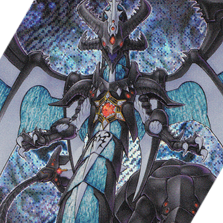

Bahamut invoked a personal incentive to make this deck. The fact that it mutates Evilswarm (or Steelswarm) monsters into a permanent version of Change of Heart is entirely too enthralling.

It’s not the most reliable monster (like Number 11: Big Eye), but it also doesn’t punish you for trying to have fun and win after its summoned. Konami seemed to think ahead when they allowed Bahamut to detach an Xyz material as the cost for its effect, while they left the discarding of the monster and taking control of the opponent’s monster to happen at resolution of the effect.

Many Fingers in Many Pies
Other than Rescue Rabbit, there’s no convenient way to summon Ophion without running a mixed bag of crappy Evilswarm monsters. That’s not to say the monsters won’t do their job, but as mentioned earlier, their sole purpose is that job. So, in order to keep things lean and provide room for expansion, tweaking, etc, this deck has access to the monsters that are driving the deck’s main goal forward. The combination of Fossil Dig and Infestation Infection act like a pseudo ROTA, ending with a Castor in hand.

Sad Faces
Evilswarm Mandragora is an interesting monster that’s both splashable and great for the archetype as a whole. So why isn’t it here? Mandrago is a double edged sword in that it allows too many opportunities to invest in the field. In a more standard Evilswarm, or even SwarmLaggia deck, it would function like Castor, increasing the consistency of turns that end in Ophion or Rank 4s. But, that’s more of the same-old-same-old kind of playstyle that this deck avoids, providing a natural buffer between big plays.

However, Monk and Upstart Golden Ninja aren’t as play-and-win. Evilswarms, and this deck in particular, do have a lot of spells and traps that could be discarded for their effects. In a deck where normal monsters are the focus, these guys feel like too much of a tangent.

Smoke and Mirrors
Considering you could just buy some HA7 packs, this deck isn’t very expensive. It manipulates a lot of cards, can thin the deck quickly, and organizes the graveyard for Dark Armed with relative ease. The most important factor, though, is that it’s not boring.
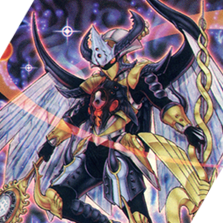
Evilswarm Kerykeion
It’s not here because I wasn’t 100 percent confident that it would release in the upcoming Lord Tachyon pack, but it has since been confirmed. Kerykeion (what a terrible name) will add a lot of really easy Rank 4s, since you can banish dead “ilswarm” Xyz mosnters (in addition to your regular ilswarms), and add their material back to your hand. It would completely change my outlook on the deck and encourage me to run Tour Guide and definitely Monk.

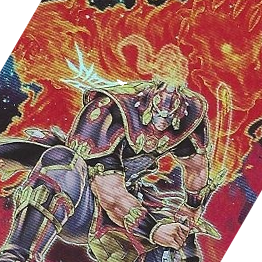
FFistArticle

A Week with Fire Fists

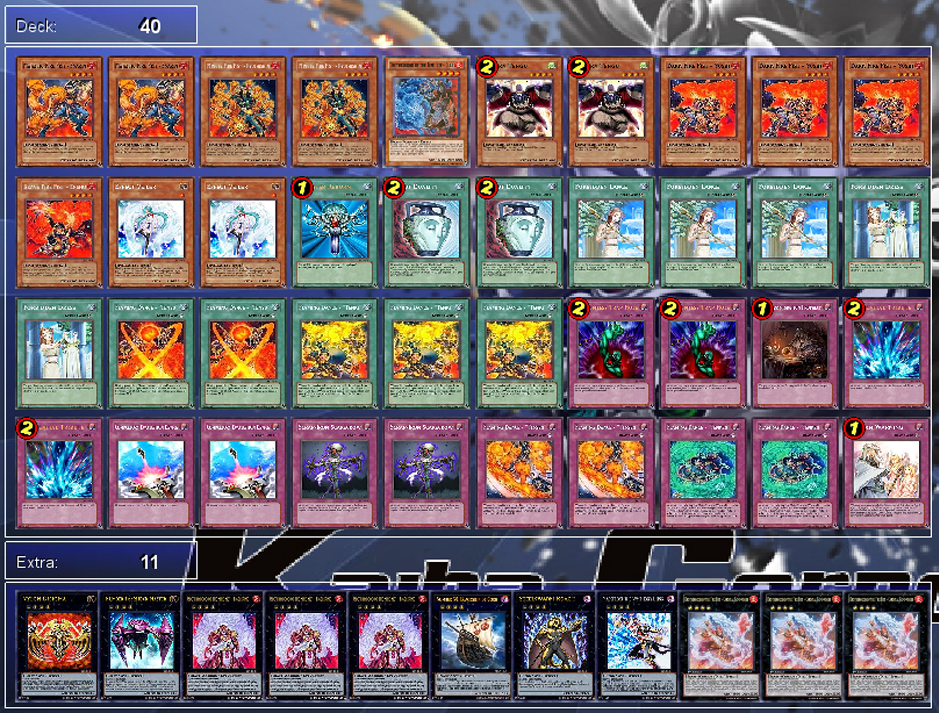
Matt here with a Fire Fist deck I’ve been running for the past week. Here’s the build for your reference: [Link].

I tried to go for an aggressive Fire Fist deck, and tested out some new cards from Lord of the Tachyon Galaxy.

Till running Fire Fists, I had underestimated the power of Bear. The deck I took to regionals, Ninja Dragons, isn’t afraid of 1600 ATK monsters that act like a better Exiled Force. But once I understood the card, I admit that I see why there’s so much hype around it.

Bear is unique in that it is a self-contained, deck-thinning destruction engine. It makes every card you can activate in the damage step lethal, on top of being a plus-1 in almost every instance. Adding it to your hand with Tenki is a plus-1, summoning Bear and destroying a monster maintains that plus-1, and then doing battle damage to search is another plus-1. Even if Bear is destroyed when it attacks, you maintain your advantage and also bait out an opponent’s backrow.

It’s so easy to keep on the field too. Forbidden Lance and Forbidden Dress do too good of a job covering you when your opponent has no monsters, or if your opponent attacks into your Bear.

I’ve run Dragon in another beast-warrior deck before and only found it somewhat useful. That continues in this more pure Fire Fist deck.

I’m not fond of Dragon, since it’s effect needs you to play Fire Formation cards out of your hand that could (should) be saved for later. While its effect does go off if you activate Fire Formation trap cards, there are not many situations where that should happen. Tensen, the ATK boosting trap card, should only be activated during the damage step so that it can avoid as much interruption as possible. There’s such a slim window for Tenken, the effect negating/protection card, to be activated while Dragon is on the field that it’s not worth mentioning.

However, all that pales in comparison to Dragons ability to Special Summon a Fire Fist monster by sending 2 Fire Formations to the grave. Fire Fists do generate backrow very quickly, but under the right conditions. I think Dragon and Bear’s effects come at a crossroads. While you want to blow things up with Bear and attack directly, you also want to use those resources for Dragon. Bear is clearly the more effective card, so how and when do you have time for Dragon? That question has lead me to view Dragon as a usable win-more card that competes with Enthusiastic King Wolfberk for space.

In contrast to Dragon, Snake seems designed as a monster that helps maintain the status quo. Every time you use Bear and Gorilla, or Special Summon with Dragon, Snake is working to eliminate all costs.

The most beneficial attribute to Snake is that it sets you up for the next two turns. Because you can set the ATK boost Tensen trap, or the protective Tenken trap, you tell get to tell your opponent that your monsters are off limits during the Battle Phase or the Main Phase. If they fail, you can use the trap that Snake provided during your turn for Bear or Gorilla.

Snake’s effect can be used during your opponents turn, so if they Heavy Storm or MST, you have a reason to chain your trap. Also interestingly enough, Snake’s effect will go off when a Fire Formation is sent from either the hand, deck, or field to the graveyard.


I wanted to try out Scrap Iron because I usually see Fire Fist monsters supported by completely obvious backrow. Instead of Fiendish Chain, I wanted a card that could be re-used. A lot of Fire Fist defense is one and done, and Scrap Iron increases pressure on the opponent immensely. Bear can survive, and combo into a Snake or Dragon, another Bear or a Gorrila. Scrap Iron saves the use of Fire Formation traps, Lance and Dress so that Bear’s effect can remove the useless Tenkis and Tensus that pile up and save those nasty surprises for later.

Scrap Iron also creates a nice buffer. Organizing the Battle Phase so that both players know exactly what’s going to happen is important for mind games. It moves things out of the damage step, that last line of defense for Fire Fists, and reinforces the importance of Bear.

Coming from Lord of the Tachyon Galaxy, Bull is another card that plays well with Snake. It’s the monster you can throw around since you can always Xyz with it. It’s not a very productive Normal Summon, but it’s great alongside a Reborn Tengu, another of the deck’s disposable monsters.

I’ve played with this deck a little over a dozen times now, and have only summoned it once. I value the monsters on the field, much more than I value Cardinal at this point. The effect to shuffle Fire Formations back into the deck is nice, but it doesn’t provide a way to get them back. So it ends fun.

Bear does its job well enough, where Cardinal just seems unnecessary. I may take out every other Xyz monster in order to focus my attention on it specifically, but that seems like too much of a chore for a deck I built for fun!

Please, Don’t Stop the Music
Konami really designed an archeytpe after a cool theme. Fire Formations (Flame Dance cards in japanese) really turn up the heat on your opponent. The quicker you can get dancing, the more secure your victory.

Jack Rabbit
Since I wasn’t building my deck around Rescue Rabbit, my view of Fire Fist cards like Bear and Dragon, are slated accordingly.

Ninja Chaos Dragons pic

Deck Profile – Chaos Dragon Ninjas

A Youtube Deck Profile of my current deck and build. It’s really fun and has gotten pretty refined over the months I’ve used it. I’d love to hear you guys’ comments though.


Monsters (29)

3 Lightpulsar
2 Darkflare
1 White-Horned Dragon
1 Eclipse Wyvern
3 Hanzo
1 Ninja Grandmaster Sasuke
3 Lyla
2 Lumina
1 Ryko
1 Gragonith
2 Tour Guide
2 Tour Bus
1 BLS
1 Chaos Sorc
1 REDMD
1 DAD
1 Honest
2 Effect Veiler

Spells (5)
1 Charge of the Light Brigade
1 Solar Recharge
1 Rota
1 MST
1 Magic Planter

Traps (8)
3 Call of the Haunted
2 Mirror Force
1 Torrential
2 Super Transformation

Extra and Side
In the video if you’re curious.

img_fi_pc_episodeDVS

Drawing versus Searching

Hey, Matt here. I’ve been thinking about this subject for a while and wanted to get your thoughts on the matter. So, Konami has transformed Yugioh into a game where you can basically leave your deck face-up for the majority of the duel, shuffling it face-down every once and awhile to draw for your turn.

It’s no surprise to anyone either, the best decks have access to their power cards quickly and efficiently, and use cards that set them up for game winning plays.

What are you doing here, Gren?

I’m talking about Merlanteans, Fire Fists, Chaos Dragons, Prophecy, Harpies, Darkworlds, Machines. These decks allow us to make decisions about the duel at its current state, and at the same time, provide us with options to invest in set-up for future turns.

If your deck relies on drawing into cards to solve problems, or help you set up, you’ll be slower than every deck Konami is producing, and doomed to fall behind.

“Draw” does have its place. Six Sams come to mind. They use United to draw like mad men, but because drawing into unpredictable cards is inferior to the options available to decks that can “perfect search,” they start to run cards that give them control over the pace of the duel, allowing them to buffer the difference in speed. But, relying on this strategy is inherently unpredictable and one of the reasons Sams are ignored by Konami.

Can you really say no?

It’s an interesting situation where you have to look at every card and really evaluate its purpose in your deck. How many monsters are competing for your Normal Summon? Can a card be used defensively and offensively? Are “staples” really doing anything to further the goal of your deck, or are they just hampering the consistency of your plays. Can you run cards that both support your deck and defend against your weaknesses?

XYZ support is another interesting factor. Dragons have incredible XYZ, Atum and Queen Dragun, while Machines have Gear Gigant and technically Big Eye, and Wind-ups had Zenmaightey. These monsters, and more – like the Karakuri Synchros – help you thin your deck and go off, allowing you to author offensive or defensive fields very quickly. We call them threats.

Decks that haven’t been spoiled have to rely on a lot of the generic XYZ monsters, whose counters are all easily accessible, and do not consistently move decks forward in their goals. Monsters like Maestroke and Utopia give less combo based decks an option to stall for cards, but those monsters are meaningless if you don’t get the cards you need. I consider these monsters “sliding scale monsters.” When I see one, I know that my opponent has taken the time to divert from their main strategy in an attempt to slow me down, thus the scale tips in my favor.

None of this is written in stone, playing smart and making good decisions during a game is just as important as running the right cards and building a good deck.

That’s my article for today, hope you guys enjoy.

img_fi_dp_cosmoblazer

Matt’s Cosmo Blazer Top 5

img_fi_dp_cosmoblazer

I think Cosmo Blazer looks like a really fun set. As you may have noticed, it seems like they’ve given the pack a lot of cards that will be good for the casual Sneak Peak duels that will be happening this Saturday and Sunday. Of course, they’re also releasing the Fire Fist archetype, those guys that, you know, reward you for playing with Snakes, Bears, and Birdies.

img_fi_sc_gimickpuppetstrings

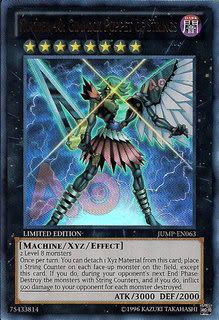
Is Number 40: Gimmick Puppet of Strings even useful?


Click to Enlarge

Generic (any two monsters) Rank 8s have a very small card pool. There’s Gimmick Puppet, and then there’s Heliopolis, a 3000/2400 monster that detaches a material to then tribute any number of monsters from your hand or the field, destroying an equal number of cards on the field in the process. So, it turns every monster in your hand and on the field into immediate 1 for 1 destruction. That’s it. These are the options until

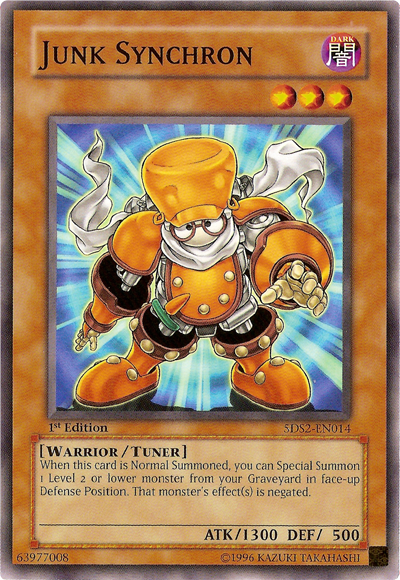
Junk Synchron

Card Review: Junk Synchron and Synchro Fusionist

Card Review: Junk Synchron with Synchro Fusionist

Junk SynchronSynchro Fusionist

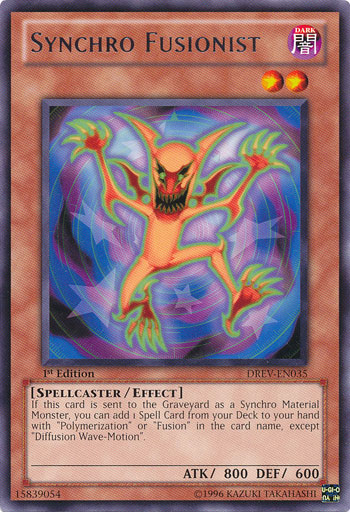
It is easy to forget that before Xyz Monsters, Synchro Monsters, and even Ritual Monsters, there were Fusions. Created to be a powerful union between two monsters, Fusions inspired duelists to dream up exciting monster combinations that used their favorite cards. Then, reality set in – Fusions were bad. Barring a handful of shining examples, Fusion Summoning has long been one of Yu-Gi-Oh’s under valued mechanics. With HEROS, and one of my favorite cards, Synchro Fusionist, Fusion Summoning has become fun and effective, allowing you to search for and set-up plays consistently.

Lumina

Lightsworns and Rank 3s

Lightsworns and Rank 3s

Lumina

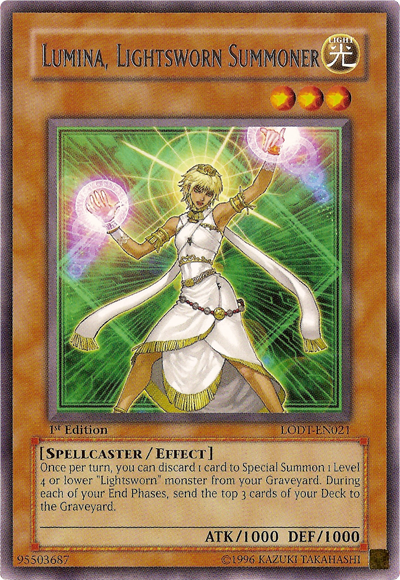
Raw power, that’s what Lightsworns had on their side during their reign at the top. It wasn’t luck that won them victory, it was their sheer overpowering advantage. A lot has changed since those fabled days, extra deck monsters encroach on their territory, speading their black and white chaos. Do Lightsworns have what it takes to adapt to this changing landscape? Perhaps with one, Lumina the Lightsworn Summoner, their light will shine a little brighter?